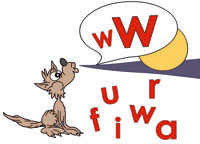
The programme “I speak therefore I write” (a Socrates Minerva European programme) wants to help all those who learn reading and writing French, regardless of age and whether they speak French as their native language or learn it as a second or third language.
Innovative pedagogical approaches have been put to use thanks to Information and Communication Technologies (ICT).
The first set of interactive games enables the user to hear, distinguish and identify the sounds that differentiate French pairs of words such as blond/blanc (blö / blä), pur/pour (pur / pwr), père/peur (per / pœr), mouche/mousse (mwh / mws), car/gare (car / gar)… A different letter is attributed to each sound. And each sound is always written with that same letter. The letters were chosen by the French linguist André Martinet in the early seventies. The sounds are those most commonly used throughout the French speaking world : see the alfonic chart below. The majority of alfonic letters have the same sound value as they generally have in orthography, thus rendering an alfonic notation close to current French spelling: Y a-t-il des macaronis à la gare ? i a-t-il de macaroni a la gar ? alfonic is always noted in red with Antique types (arial, century gothic or tahoma for example). alfonic letters are not linked (ligatured as in handwriting), in order to improve legibility but also to allow for a systematic distinction from standard spelling. They do not contain Capital or italic fonts as they are pronounced the same.
The student then goes on to use alfonic to write. He or she is asked to choose and arrange the correct letters in the right order to note some of the words that he or she is asked to listen to in the games. Gradually he or she discovers that as soon as he or she has identified the sounds and their sequence he or she can write French : “I speak therefore I write.” Simultaneously, he or she is now able to read the messages that his friends write in the same comfortable spelling. At that time the two faces of written communication have been acquired.
Then the student will try to read whatever he or she can see written in French. He or she is stimulated to do so by other games and pleasant stories such as Little Red Riding Hood. He knows the plot but will be delighted with many amusing details revealed by the exact wordswhose meanings are often suggested by comic or charming drawings. The stories are now offered in orthography but, every time he or she or she clicks on an unknown word or on a word whose pronunciation seems farfetched as against its letters, alfonic pops up together with the sounds.
Reading texts makes the student realise that the current French spelling has its own rules. The Ugly Duckling is specially designed to help him or her discover the logic behind these unexpected and often unpronounced regularities. Cheerful games are offered to play with these discrepancies and tame them. So the French orthography sets in little by little. alfonic remains available at the tip of a click whenever needed but is no longer the target, standard written French is. alfonic, however, may continue to help acquire or memorise the pronunciation of new words.
“I speak therefore I write” is an international and multilingual European programme. It has been tested for two years by linguists and teachers together from France, Belgium, Italy, Greece, Rumania and Poland. Some of the students belonged to regular classes and alfonic was used in the classroom. Some had dyslexia problems and were offered help at home or in special rooms. It has consistently been noted that alfonic helped French speaking children in both kindergartens and primary schools as well as adults who could neither read nor write French. Foreign students appreciate the straightforwardness and “transparency” of alfonic when first discovering French, since that language is famed for the intricacies of its spelling and grammar. They also enjoy its enormous help in showing how to pronounce it. All its “mysterious” rules and mechanisms then appear less fearful.
alfonic was created by André Martinet and its implementation has been coordinated by Raphael, Recherches sur l'Application de la Phonologie aux Apprentissages de l'Ecriture et de la Lecture, Paris. It was initially dedicated to helping French speaking pupils severely in need vis-à-vis French spelling. It turned out to be precious in revealing vocabulary and stimulating curiosity towards writing and reading French, with all ages.
As such, alfonic is not designed for other languages and writing systems. But its principles and our experience may be put to use for those languages which, like French, show an often striking distance between sounds and lettersEnglish, for instance.Jeanne MARTINET
May 2005